Welcome to our biweekly series in partnership with CIDRAP at the University of Minnesota.
I (Izzy) am writing this while drinking coffee from my favorite Shakespearean insults mug, which feels like the right companion for a post about language. Shakespeare understood that a well-chosen word has the power to hurt, flatter, or completely change how we see something.

Juliet’s famous line “What’s in a name? That which we call a rose / By any other name would smell as sweet” is a lovely sentiment, and it holds some truth. The rose doesn’t change. But what we expect of it and whether we trust it shift alongside the label. Words are more than a decoration. They tell us what to expect and what to do next.
That idea was on my mind on September 23, when the U.S. Department of Health and Human Services (HHS) updated their Interim Clinical Considerations for Use of COVID-19 Vaccines. HHS oversees the Centers for Disease Control and Prevention (CDC), and this guidance is written for clinicians and public health officials to use when patients ask about vaccination. Last week, we compared it with the May 1, 2025, version word for word, but a social media post only fits so much. So first, a quick run-through of this edition’s policy updates, then a deep dive. Let’s discuss…
The PDF version of today’s update is here. Read past installments here and today's update on the Unbiased Science Substack here.
The State of U.S. Vaccine Policy, in Brief
HHS launched a vaccine injury initiative, a U.S.-funded hepatitis B vaccine trial in newborns drew more pushback, and New York declared a measles emergency. There were also updates in the courts and in Florida.
HHS launches a vaccine injury initiative, which includes paying doctors for Vaccine Adverse Event Reporting System (VAERS) reports
On October 8, HHS announced:
- A National Institutes of Health (NIH) clinic to study and treat people who experience health problems after vaccination
- A Centers for Medicare and Medicaid Services (CMS) proposal to pay physicians for filing reports to VAERS
- A requirement that electronic health records capture vaccine-related adverse events
- A CDC contract to update VAERS
Here’s the gist: We ALL want vaccine safety, and we already have monitoring systems with a track record of catching rare side effects (it’s how a rare clotting disorder was linked to the Johnson & Johnson COVID-19 vaccine in 2021), so implying otherwise is misleading. Anyone can submit a VAERS report, and a report alone doesn’t show that a vaccine caused anything. Without research into those reports, more submissions could be mistaken for evidence of more harm. HHS Secretary Robert F. Kennedy Jr. said HHS must not “dismiss or gaslight” families who report vaccine injuries. Taking them seriously means investigating what actually caused their symptoms. The CMS piece is still a proposal, and we’ll be sure to flag it if and when it opens for public comment.
If the goal is to help injured families, the most direct fix is the compensation backlog, in which claims take two to three years, and none of these actions address it. We’re also worried about the Vaccine Injury Table, which HHS can change without Congressional input. When a listed injury occurs within a set time window after receipt of a specific vaccine, causation is generally presumed. Most childhood vaccines are given in the first few years of life, which is also when autism is typically diagnosed, so depending on how wide that window is set, a huge number of families could become eligible for compensation over a link that decades of research (and vaccine court itself) have found no evidence for. That could drain the compensation fund and push manufacturers out of the market, as lawsuits did in the 1980s. For more information, read our October 10 piece.
Guinea-Bissau says it hasn’t authorized a U.S.-funded trial that would delay hepatitis B vaccine for some newborns
Facing a September 30 deadline to spend funds, CDC officials pulled $1.6 million for a trial in Guinea-Bissau from funds Congress designated for global health security (money that could have gone toward the Ebola outbreak in the Democratic Republic of Congo), Rolling Stone reports. The trial would enroll 14,000 newborns. Half would get the hepatitis B vaccine at birth, and half would wait until 6 weeks, the country’s current schedule. More than 12% of adults there have chronic hepatitis B, and about 90% of babies infected at birth develop chronic infection.
One core requirement for a randomized trial is clinical equipoise, meaning real uncertainty about which option is better for participants. The researchers want to study broader outcomes like overall deaths, but there’s no credible uncertainty that a timely birth dose protects newborns from hepatitis B (it prevents 70% to 95% of mother-to-baby transmission). They argue that no baby would get fewer vaccines than the national schedule provides. Guinea-Bissau already plans to add the birth dose by 2028, and in February, the World Health Organization called the trial unethical, noting that limited resources can’t justify withholding proven care in a study. The Hepatitis B Foundation and the African Hepatitis B Advocacy Coalition have also denounced it.
On September 30, an ethics committee at the University of Southern Denmark voted five to four to affirm the trial. Two members told Rolling Stone that the expiring funds rushed deliberations and that the vote was scheduled before all members could attend, and at least four members have since resigned. The dean gave final approval on October 7, though the trial can’t begin without Guinea-Bissau’s authorization. On October 13, Guinea-Bissau’s health minister said the government never authorized it and that it would need further review.
An appeals court heard the government’s challenge to the ruling that paused Kennedy’s vaccine advisory committee
The ACIP (Advisory Committee on Immunization Practices) is the panel of outside experts that advises CDC on who should get which vaccines. Its recommendations shape insurance coverage and the vaccines available through Vaccines for Children. In June 2025, Kennedy fired all 17 members and replaced them with his own picks, several of whom had publicly questioned vaccine safety. The American Academy of Pediatrics (AAP) and other medical groups sued in AAP v. Kennedy. They argue that the new committee lacks the balance and expertise federal law requires and that Kennedy changed the childhood vaccine schedule without following proper process. In March, a federal district court paused both the rebuilt ACIP's appointments and votes and Kennedy's changes to the childhood vaccine schedule while the case continues.
The government appealed only the ACIP part, and the First Circuit heard arguments on October 6. The schedule pause stays in place either way. If the court lifts the ACIP pause, HHS could go back to using the rebuilt committee to make new recommendations. The ruling doesn’t stop Kennedy from appointing new members, as long as the committee meets those legal requirements. We’ll cover the decision when it comes.
Florida drops a proposed vaccine exemption but still plans to end four school vaccine requirements
On September 30, Florida’s health department dropped a proposed new vaccine exemption that would have let parents opt their kids out of school vaccines based on “sincerely held moral or ethical beliefs,” leaving the existing medical and religious exemptions in place. It still plans to end school and childcare requirements for the hepatitis B, chickenpox, Haemophilus influenzae type b (Hib), and pneumococcal vaccines, which would remain available but no longer be required. Because these requirements are set by agency rule, the department can drop them without the Legislature’s input. Doctors, parents, and a 7-year-old cancer survivor testified against the plan at an October 8 hearing. Comments are open until October 19 at vaccinerule@flhealth.gov.
New York declares a measles emergency
On October 5, New York declared a measles disaster emergency, the first since cases began rising in 2025. The state has 108 cases so far this year, mostly in rural communities with low vaccination rates. The order temporarily lets more types of health professionals give the measles, mumps, and rubella (MMR) vaccine.
Pennsylvania has reported 1,222 cases this year, and a sixth measles-associated death there was reported October 12. In November, the Pan American Health Organization will decide whether the United States keeps its measles elimination status. Meanwhile, a new Annenberg poll found that only 31% of adults know Kennedy recommends the MMR vaccine.
The federal vaccine-finder website isn’t working
Vaccines.gov currently rejects every ZIP code as invalid. Vaccinefinder.org still works, as do pharmacy websites and your clinician’s office.
What’s in a Name? CDC’s September 2026 COVID-19 Vaccine Guidance
A note before we begin: CDC remains home to many dedicated public health professionals, and this analysis isn’t a critique of their work.
A clinician who read the May 2025 COVID-19 guidelines and the September 2026 guidance may come away with different impressions. The recent changes shift the emphasis of the guidance from benefits to risks. Statements that the benefits of vaccination outweigh the risks were removed from key sections, while package-insert language about “unknown” risk and a new list of serious adverse events were added. An independent review by CIDRAP’s Vaccine Integrity Project (VIP), published in JAMA on September 2, included 155 new studies and found no new safety concerns.
Why so many updates?
CDC's COVID-19 guidance has changed several times in the past two years, tied to the legal fight over who sets the vaccine recommendations we covered in the previously mentioned brief. The May 1, 2025, version predates Kennedy's May 27 directive, and the September 23, 2026, version came after the federal court stayed many of the changes that followed. The timeline shows where each version falls, which helps explain why they read so differently.

Key dates in CDC’s COVID-19 vaccine guidance and AAP v. Kennedy, created by Unbiased Science.
ACIP, Advisory Committee on Immunization Practices; CDC, Centers for Disease Control and Prevention; MMWR, Morbidity and Mortality Weekly Report; VAERS, Vaccine Adverse Event Reporting System.
What stayed the same?
The adult recommendation is the clearest line in the new guidance: “A 2026-2027 COVID-19 vaccine is recommended for all adults ages 18 years and older in the United States for the prevention of COVID-19.” As in May 2025, all adults are recommended to get vaccinated.
The new version adds notes marking some recommended uses as “off-label,” because the U.S. Food and Drug Administration (FDA) approved the vaccines for fewer people and fewer doses than the guidance recommends. FDA approved this season’s vaccines for adults 65 and older and for adults under 65 with at least one high-risk condition, so vaccinating healthy adults under 65 is off-label. For adults 65 and older, the guidance recommends two doses six months apart, while noting that “giving more than one dose of COVID-19 vaccine to adults ages 65 years and older is off-label use.” The term “off-label” can sound alarming, but off-label use is legal and common. Here, it simply means the recommendation goes further than the label.
What the evidence shows: Updated vaccines cut the risk of COVID-19 hospitalization by about half in adults 65 and older and in adults 18 through 64, according to the
review. The American Academy of Family Physicians (AAFP) also recommends a COVID-19 vaccine for all adults, especially those 65 and older, those at higher risk, and those never vaccinated.
What happened to the pregnancy section?
The pregnancy section shows the shift most clearly. Here are the two versions side by side:
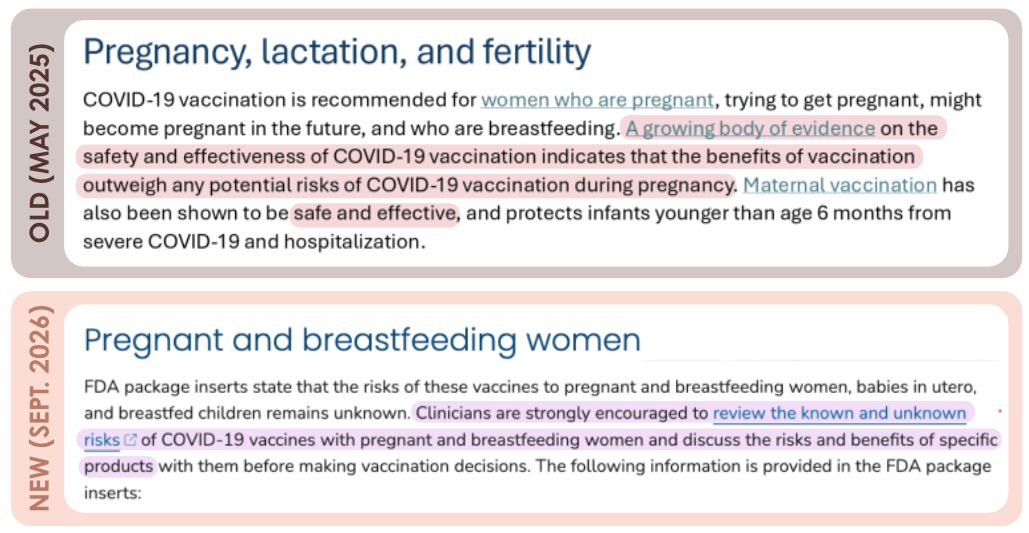
The section highlighted in red was removed entirely. The purple highlight reads like a new instruction, though discussing risks and benefits has always been part of prenatal care.
FDA, Food and Drug Administration.
In place of the May 2025 language, the guidance quotes the pregnancy and lactation parts of the package inserts for each of this season's four COVID-19 vaccines. A package insert is a regulatory label, and using it instead of an evidence summary puts "unknown" and "risks" front and center.
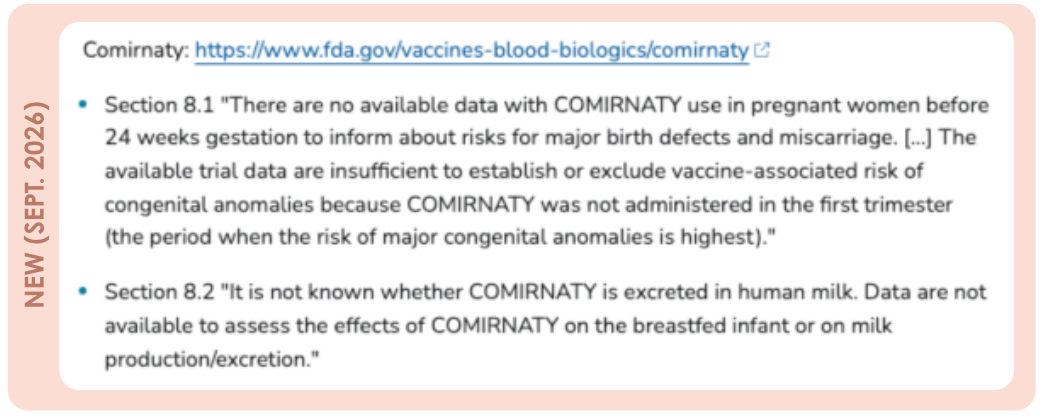
Example package insert for the Comirnaty COVID-19 vaccine that was added to the CDC’s guidance.
The new version no longer addresses people who are trying to get pregnant. It also drops the May advice that acetaminophen (Tylenol) can be offered for fever after vaccination during pregnancy, since fever during pregnancy has been linked to complications.
Pregnant women are still covered by the recommendation for all adults. But the guidance no longer includes any summary of the evidence.
Until very recently, CDC's page for the public still said that "the benefits of receiving a COVID-19 vaccine outweigh potential risks of vaccination during pregnancy." That page, updated as recently as October 8, now redirects to the clinician guidance.
Recent studies have found:
- Maternal vaccination was associated with about half as many COVID-related hospital visits in infants’ first two months.
- Maternal vaccination reduced COVID-related emergency and urgent care encounters among pregnant women by 58%.
- In about 140,000 pregnancies in Quebec, Canada, vaccination did not raise the risk of stillbirth, preterm birth, or small size for gestational age.
- In 527,564 infants, first-trimester mRNA vaccination was not associated with major birth defects.
The American College of Obstetricians and Gynecologists (ACOG) recommends a COVID-19 vaccine for people who are considering pregnancy, pregnant, recently pregnant, or breastfeeding. The AAFP also recommends vaccination during any trimester and during lactation.
Why does ‘least favorable’ matter for kids?
In May 2025, the guidance said: "COVID-19 vaccination is recommended for everyone ages 6 months and older in the United States for the prevention of COVID-19.”
The September 2026 guidance changed that for children:
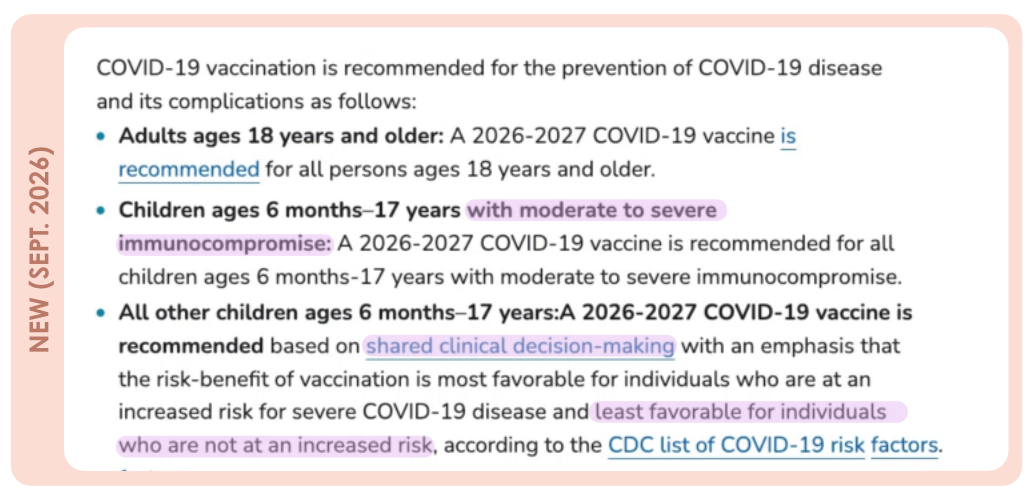
In this guidance, "least favorable" covers children of every age, including babies and toddlers. As with adults, the guidance also marks vaccinating healthy children as off-label, because FDA approved the vaccines only for children with at least one condition that raises their risk of severe COVID-19.
What the evidence shows:
- Many children hospitalized for COVID-19 are babies and toddlers, and the AAP’s technical report notes that severe disease occurred "in otherwise healthy young children." From October 2022 through April 2024, children 6 through 23 months accounted for about 45% of COVID-19 hospitalizations among vaccine-eligible children, and more than half of them had no underlying medical condition.
- The 2024-25 vaccines cut COVID-19 emergency and urgent care visits by about three-quarters in young children and by more than half in older children and teens.
Off-label doesn't mean unsafe. VIP’s review of new studies found no new safety concerns.
The AAP recommends vaccination for all children 6 through 23 months and says any child whose parent or guardian wants them protected should be offered the vaccine.
What about myocarditis?
The myocarditis sections in the two versions are quite similar. Both describe myocarditis and pericarditis after vaccination as rare. Both also say that vaccine recipients, especially males ages 12 through 39, should be told about this rare risk and about "the benefit of COVID-19 vaccination in reducing the risk of severe outcomes from COVID-19."
What's gone is the conclusion that the benefits of vaccination outweigh this rare risk. In May 2025, the guidance said ACIP and CDC "determined that the benefits of COVID-19 vaccination (eg, prevention of COVID-19 and its severe outcomes) outweigh the rare risk of myocarditis and pericarditis in all populations recommended for vaccination." That sentence isn't in the September 2026 version.
What the evidence shows:
- The new guidance presents figures showing that myocarditis was 10 times more common after having COVID-19 than after vaccination (0.05% vs 0.005%) in a study of more than 4 million people ages 16 through 25. But those figures appear only in a table footnote on another page, not in the myocarditis section.
- The AAP report finds that vaccine-associated myocarditis has been rare, concentrated in adolescent males after the second dose of the primary series, and generally milder and that most young people who had it fully recovered. Rates have also been lower with newer vaccine formulations.
- The VIP independent review found no studies showing increased myocarditis rates among people vaccinated after 2022, when CDC began advising a longer interval between the first and second doses.
What’s new on the CDC’s safety list?
The September 2026 safety page adds a list titled, "Serious Adverse Events (Confirmed Causal or Strong Signal)." The May 2025 version did not have this list.
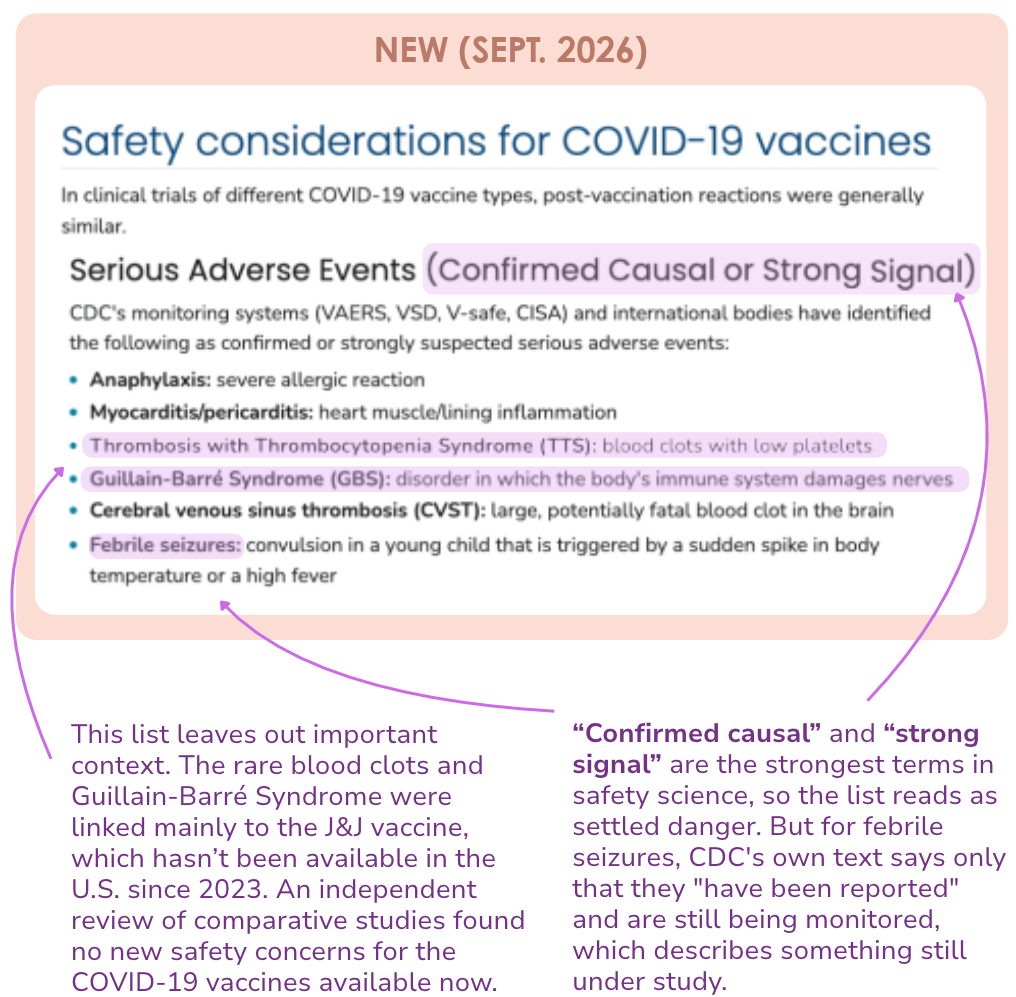
CDC, Centers for Disease Control and Prevention; CISA, Clinical Immunization Safety Assessment; VAERS, Vaccine Adverse Event Reporting System; VSD, Vaccine Safety Datalink.
Some entries, like anaphylaxis and myocarditis, are established risks. Febrile seizures are different: CDC's own paragraph on them changed. In May 2025, it said, "CDC postmarketing safety surveillance for mRNA COVID-19 vaccines has not identified a safety concern for febrile seizure in children ages 6 months–5 years." That sentence is now gone.
What the evidence shows: The AAP report reviewed the febrile seizure data, including an FDA signal in young children after the original vaccines. A follow-up study found about three extra cases per 100,000 Moderna doses and no significant increase after Pfizer’s. AAP concludes that “the available evidence does not support a consistent febrile seizure safety signal.” The same report found no safety signal for Guillain-Barre syndrome (GBS) or for blood clots after mRNA vaccination in children and teens. Finally, febrile seizures can happen with any fever in young children and usually cause no lasting harm.
Do small words really matter?
Some of the changes are only a word or two, which makes them easy to skim past. Giving COVID-19 vaccine at the same visit as other vaccines (and alongside the antibodies that protect infants from RSV) went from "recommended" to "acceptable." "CDC recommends that people stay up to date with COVID-19 vaccination" was removed. A new line says "COVID-19 vaccination is not guaranteed to prevent infection with or spread of SARS-CoV-2." That's true for vaccines in general, but the main benefit of COVID-19 vaccines has always been preventing severe illness and hospitalization.
What do we do with this?
We can't say why these edits were made, and we won't guess. What we can say is that the evidence supporting these vaccines has grown, while key statements about their benefits have disappeared from the guidance.
The guidance still recommends vaccination for all adults, and the medical societies that care for these patients have expanded their recommendations. ACOG recommends vaccination before, during, and after pregnancy, the AAP recommends it for young children and older children at higher risk, and the AAFP recommends it for all adults. Each based its recommendations, at least in part, on the VIP’s 2026-27 review, which any clinician can use.
Finally, we want to take a moment to honor the inimitable Helen Branswell, STAT’s infectious disease reporter, who died October 13 at 69. She spent more than two decades explaining severe acute respiratory syndrome (SARS), flu, polio, Ebola, and COVID-19 to the public, and she never hyped a threat beyond what the evidence showed. The day before she died, she was still sharing new data on maternal RSV vaccine uptake with her colleagues from the hospital. This is a monumental loss for the public health community. We were all better informed because of her work, and we’ll miss her dearly.
Stay Curious,
Unbiased Science