Feb 6, 2004 (CIDRAP News) – The United Nations Food and Agriculture Organization (FAO), downplaying statements by a regional FAO official, said today it had no evidence that pigs are involved in transmitting the H5N1 avian influenza virus in Asia.
At the same time, the World Health Organization (WHO) announced it had found no mutation of the avian flu virus in connection with a family cluster of human cases in Vietnam. Disease experts fear that the avian virus could trigger a human flu pandemic if it mutates into a new strain that could spread easily from person to person.
The reassuring statements came as two more human deaths from the avian flu were reported in Vietnam, bringing the death toll to 18.
In an FAO statement today, Peter Roeder, a veterinary virologist and animal health expert, said, "At this time we have seen no data that would indicate that pigs are in any way involved in spreading the current strain of H5N1 influenza virus."
Earlier today, news reports quoted Anton Rychener, FAO representative in Hanoi, Vietnam, as saying nasal swabs from pigs in and around Hanoi had tested positive for the virus. He did not say how many pigs had been tested or which lab did the testing, according to an Associated Press (AP) report.
Disease experts are worried that the widespread avian flu outbreak in Asia could lead to mixing of the avian virus with a human flu virus, potentially creating a new strain that could trigger a flu pandemic. Pigs are believed to have played a role in past pandemics by providing a mixing vessel for avian and mammalian flu viruses. There have been at least 20 confirmed human cases of H5N1 infection. So far, humans are believed to have contracted the virus directly from poultry, not from pigs.
Study showed no virus in pigs
The FAO said a recent study in Vietnam by Robert Webster, director of the WHO Collaborating Laboratory on Animal Influenza in Hong Kong, showed no evidence of the H5N1 virus in swine.
"Right now, there is no justification for saying there is H5N1 virus infection in pigs in Vietnam," Webster said in the FAO news release. "Until either a virus is isolated from within an animal or there are antibodies to show infection the question of transmission remains wide open."
FAO officials said it is not unusual to find flu viruses in pigs' nostrils. In the current situation, "It should not be considered unexpected if the H5N1 virus were to be detected in swine in contact with poultry," they added.
The agency said the presence of a virus in the nostrils does not necessarily mean a pig is infected but does indicate that further testing is needed, according to an AP report. Finding virus in blood samples would be a more conclusive sign of infection. The FAO recommended that all swine illnesses suggestive of influenza be reported to health authorities and thoroughly investigated.
Today's WHO announcement said an analysis of viral material from two Vietnamese sisters who died of avian flu showed that the viruses were of avian origin and contained no human influenza genes. "This finding, which indicates that the virus has not changed to a form easily transmitted from one person to another, is consistent with earlier findings from epidemiological investigations," the agency said. No illness was reported in other family members, in the local community, or in healthcare workers.
The two sisters, aged 23 and 30, were among four family members who had confirmed or suspected cases of avian flu. A brother of the two sisters died of what was suspected to be avian flu, but his body was cremated and no testing was done, the WHO said earlier. The man's wife also was sick but recovered without being tested. Because two of the patients had no history of direct exposure to poultry, person-to-person transmission was suspected, triggering an investigation.
News services today reported that a 6-year-old girl and a 24-year-old man died of avian flu in Vietnam. The deaths raised Vietnam's toll in the outbreaks to 13 and the global toll to 18, including five deaths in Thailand. The reports did not make clear whether the cases had been confirmed previously as avian flu or were confirmed after the patients died.
US bans birds from affected countries
In other developments, US officials this week announced a temporary ban on importation of birds from eight countries affected by the avian flu: Cambodia, Indonesia, Japan, Laos, China (including Hong Kong), South Korea, Thailand, and Vietnam. The ban applies to birds and bird products but not to products processed to make them noninfectious, the US Department of Agriculture (USDA) said.
"These imports were already under tight restrictions because of the presence of exotic Newcastle disease in these countries," said Agriculture Secretary Ann Veneman.
The USDA said the United States imports an estimated 20,000 birds annually from the countries with current avian flu outbreaks. Because of exotic Newcastle disease, permits were already required to import pet birds and bird products from these countries, and live birds and hatching eggs had to be quarantined for 30 days after entry into the country.
In the announcement, Secretary of Health and Human Services Tommy G. Thompson said there was no evidence that any birds infected with avian flu had been imported so far.
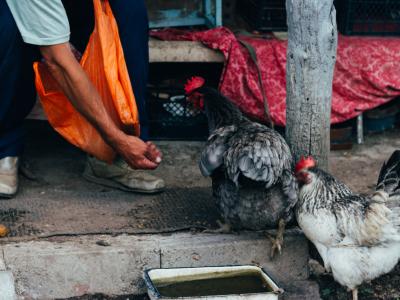
In other news, the New York-based Wildlife Conservation Society this week said closing Asia's wild bird markets would help reduce the spread of avian flu. "The markets place tens of thousands of wild and domestic birds in close quarters, allowing diseases to make the jump between wild animals, livestock, and ultimately humans," the group said in a Feb 3 statement.
See also:
Feb 6 FAO statement on lack of evidence of H5N1 virus in pigs
http://www.fao.org/newsroom/en/news/2004/36787/index.html
Feb 6 WHO statement on family cluster of cases
http://www.who.int/csr/don/2004_02_06/en/