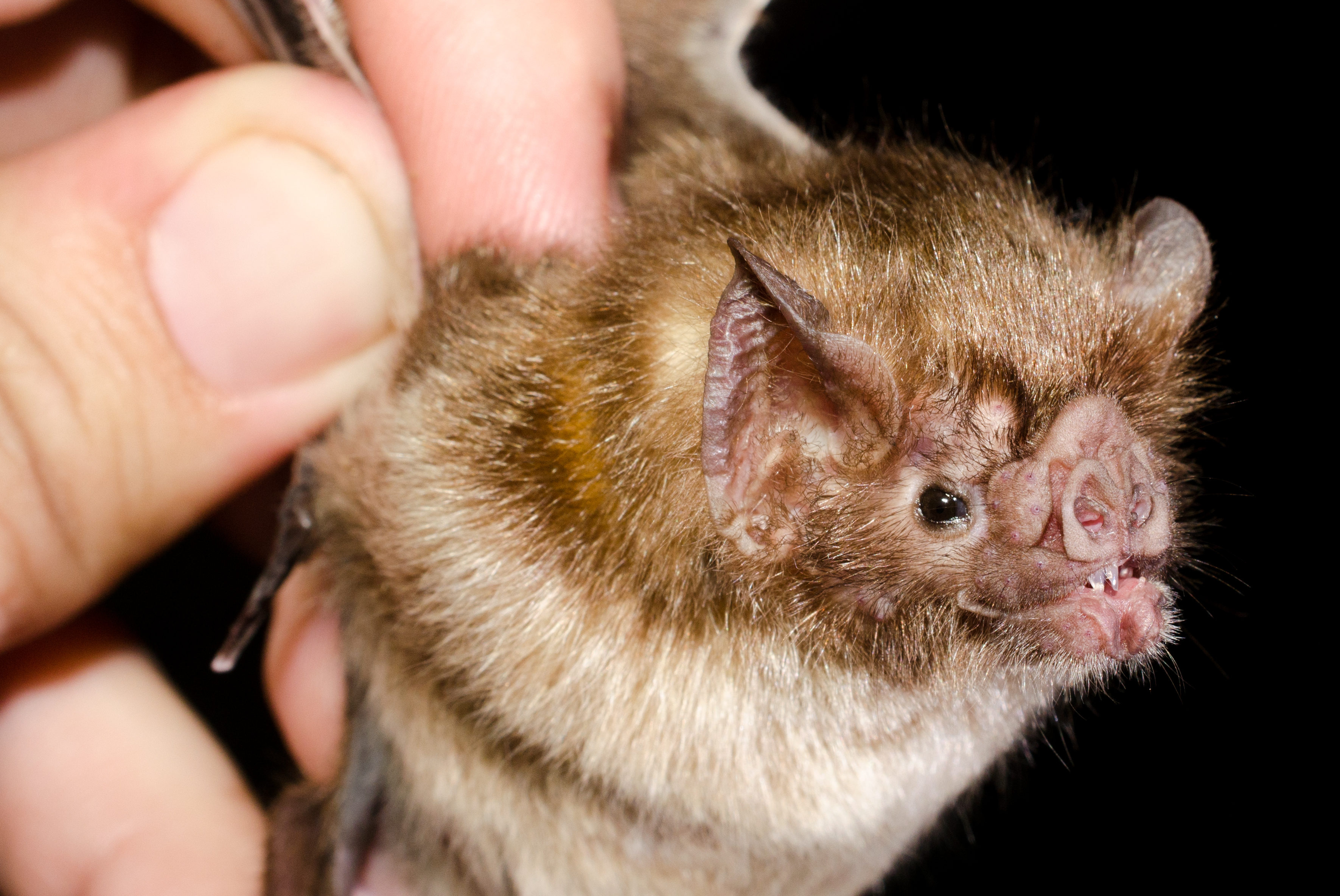
During a 2022 field expedition, Peter Larsen, PhD, was asleep in an open-air house in Guyana when he was awakened by the sensation of liquid on his feet, which were pressed against his mosquito net—except it wasn’t raining. He flicked on his headlamp, startled to find that the liquid was blood, and a vampire bat—a species he had gone there to study—was feeding on him.
That experience, along with his work with vampire bats in several Central and South American countries, prompted Larsen to ponder the pathogens the bats might carry. Specifically, as co-director of the Minnesota Center for Prion Research and Outreach (MNPRO), he wondered about vampire bats’ potential role in spreading the prions (infectious misfolded proteins) that cause chronic wasting disease (CWD) in cervids such as deer, elk, and moose.
The fatal disease has been spreading in North America for decades and has now been found as far south as New Mexico and Texas, with a prevalence as high as 11% in mule deer in one area. At the same time, climate change is driving vampire bats northward, and they are predicted to arrive in Arizona, New Mexico, and Texas in the next 10 to 50 years.
Common vampire bats (Desmodus rotundus) in northern Mexico, Larsen thought, may already be feeding on CWD-positive cervids there, further transmitting the prions. “If I had to guess, I would say it's 70% possible that there are already vampire bats feeding on [CWD-] positive animals in Mexico,” he said.
Larsen’s curiosity led him, along with coauthors Lexi Frank, a University of Minnesota PhD student and research assistant, and Jason Bartz, PhD, a professor at Creighton University, to investigate the potential interface of bats and CWD prions, which Larsen called a national security issue. The team published the findings in the Journal of Mammology.
‘It turns into a nightmare if it's real’
The fist-sized common vampire bats are known to feed on the blood of livestock, wildlife, and people by injecting an anticoagulant through a painless bite with razor-sharp teeth. The bats often regurgitate blood meals to share with other bats in their roosts who didn’t get their own, as well as participate in communal grooming—another potential transmission route.
In addition, captive cervid herds used for hunting, venison, or other byproducts are relatively common in southern Texas and Mexico, representing ample opportunity for the bats to feed. Cervids with clinical CWD, which often features cognitive impairment and limited mobility, would be especially vulnerable.