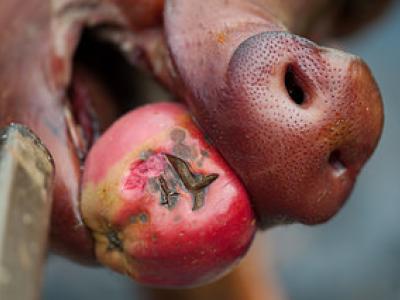
Roasting a pig is a complex process, with several food safety steps to keep in mind.
A Salmonella outbreak linked to stuffed, raw chicken entrees that might appear to be cooked has grown to nine cases, as new individual cases in Minnesota and Illinois push the number of affected states to four, the Centers for Disease Control and Prevention (CDC) said in an update yesterday.
The agency reported seven outbreak cases on Jul 16.
South Korea has gone 15 days without reporting a new MERS-CoV case, keeping the total at 186 cases, the country's Yonhap News Agency reported today. No deaths have been reported in 9 days, keeping the fatality count at 36.
The country will be considered free of the virus if it goes two incubation periods, a total of 28 days, without a new case.
An outbreak of Salmonella infections linked to raw, frozen, stuffed chicken products has grown to seven cases, with Oklahoma announcing its first case, the Centers for Disease Control and Prevention (CDC) said yesterday in an update.
Seven new cases of salmonellosis linked to frozen raw tuna have increased the current outbreak total to 60 cases in 11 states, an increase of 2 states since the last update on Jun 5, the Centers for Disease Control and Prevention (CDC) said yesterday.
The outbreak is caused by Salmonella Paratyphi B variant L(+) tartrate(+) bacteria, formerly known as Salmonella Java, the CDC said.
Minnesota health officials yesterday linked two recent Salmonella infections to an unusual multistate outbreak tied to raw tuna. The outbreak, first announced by the US Centers for Disease Control and Prevention (CDC) on May 21, involves Salmonella Paratyphi B variant L(+) tartrate(+). As of Jun 5, the CDC had received reports of 53 cases from 9 states.
After going 9 straight days without a MERS-CoV case, Saudi Arabia today reported two.
A large study in Bangladesh of oral killed whole-cell cholera vaccine found that it cut disease rates in half, even with moderate coverage, according to a report yesterday in The Lancet.
Texas health officials reported today that the the state's surge of Cyclospora infections has reached 103, including 91 cases in the past 2 weeks.
The Texas Department of State Health Services (TDSHS) said cases have been reported in at least 22 of the state's 254 counties, but the largest portion—38 cases—are in Travis County, which includes Austin.
The outbreak with links to chicks and ducklings involves four different strains.