In Science, researchers from Stanford University and the Broad Institute report that the functional bacteriophages they created using artificial intelligence (AI) rapidly destroyed strains of Escherichia coli that had evolved resistance to naturally occurring phages, but experts call for safeguards to prevent the technology from being used for harm.
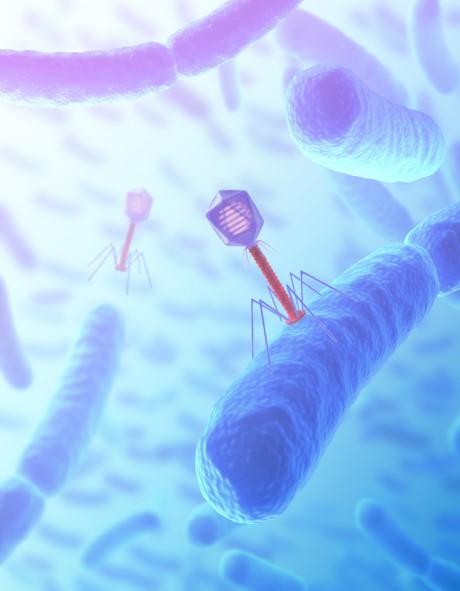
Bacteriophages are ubiquitous viruses that target, infect, and kill only bacteria. They are found everywhere bacteria live, including the environment and the human gut, and they can be used to treat bacterial infections.
Using the ΦX174 bacteriophage as a model, the team combined their previously built genomic language models with computational biology to produce 16 complete bacteriophages with substantially different genomes.
“Even the simplest genomes are highly complex and can be rendered nonviable by a single mutation,” the authors wrote. “Design at the scale of whole genomes has remained largely beyond reach.”
Urgent biosafety, biosecurity questions
Some engineered phages performed comparably to naturally occurring relatives, and some combinations overcame two strains of E coli resistant to ΦX174-like phages.
“Our approach expands what synthetic genomics can achieve alongside methods such as directed evolution and rational engineering, lays out a path for generating adaptive and resilient phage therapies against rapidly evolving pathogens, and establishes a foundation for the generative design of larger, more complex genomes,” the researchers wrote.
Using such training data to generate genomes of eukaryote-infecting pathogens should not be pursued.
In an accompanying commentary, Thomas Inglesby, MD, and Moritz Hanke, MD, both of Johns Hopkins University, warn that although the finding is promising, “it also raises urgent biosafety and biosecurity questions. The ability to compose viral genomes using generative AI now exists; the governance to safely steer it does not.”
They caution that this technology could be used to create non-therapeutic bacteriophages in eukaryotes such as humans, animals, and plants.
“Using such training data to generate genomes of eukaryote-infecting pathogens should not be pursued,” they wrote. “Such genomes might encode new pathogens that can infect humans, animals, or plants in ways that cannot be contained by existing countermeasures.”
They recommend adapting existing safety frameworks to generative genomics and excluding sensitive viral sequences from training data.