Sen. Mitch McConnell, a Kentucky Republican, has explained his month-long absence from Congress as the result of a fall at home, caused by complications from the polio infection he survived as a child.
“Surviving childhood polio meant spending my entire life with mobility challenges,” said McConnell, 84, in a July 12 statement. “They haven’t exactly gotten easier to manage with age. And last month, I took a fall which landed me in the hospital.”
Many people today know of polio—which paralyzed up to 58,000 Americans a year at its US peak—only through history books. Thanks to vaccination, the disease was eliminated in the United States in 1979 and throughout the Western Hemisphere in 1994. Today, wild poliovirus circulates routinely only in Afghanistan and Pakistan.
Yet the poliovirus continues to harm nearly 300,000 Americans in the form of post-polio syndrome, an array of medical problems that occur decades after the original infection. After years of health, 25% to 40% of polio survivors may suffer pain, renewed muscle weakness, fatigue, and problems speaking or swallowing. In some cases, people lose strength in a limb that had been unaffected before.
McConnell, the former Senate majority leader, has long had an unsteady gait, and has fallen several times in recent years. He is often seen using a wheelchair to get around the Capitol.
“It’s really the second wave of polio,” Carol Pandak, PhD, director of PolioPlus, Rotary International’s global effort to eradicate polio, told CIDRAP News. “It’s devastating for people to once again see your body failing because of polio,” said Pandak, who has spoken with many polio survivors. “People never wanted their lives to be defined by polio.”
Fading memories of a terrifying disease
In the United States, most polio survivors are in their 70s or 80s. The number of people with post-polio syndrome is declining, as survivors age and pass away.
Around the world, the burden of polio is much greater, with estimates showing as high as 15 million to 20 million suffering post-polio symptoms.

Centers for Disease Control and Prevention.
In countries such as India, which didn’t eliminate polio until 2014, “there’s a whole generation who will be experiencing this,” Pandak said. “This wave of post-polio has yet to hit them. We have only seen the tip of the iceberg.”
McConnell is far from the only famous person to have survived polio. Well-known survivors include virtuoso violinist Itzhak Perlman, actor Alan Alda, and golfer Jack Nicklaus. A handful of celebrities, including singer and songwriter Joni Mitchell, have spoken publicly about their post-polio symptoms.
Some aren’t surprised that so many polio survivors have reached the height of success.
It’s devastating for people to once again see your body failing because of polio.
Polio survivors are often described as having “type A” personalities, perhaps because they had to work so hard to overcome paralysis, said Daniel Ryan, MD, a physiatrist at the Center for Physical Medicine and Rehabilitation in Warren, Michigan, one of a limited number of clinicians with experience treating post-polio syndrome.
March of Dimes/Wikimedia Commons
Survivors of the disease are “often very successful compared to the average population, because they had a very strong attitude to push through,” Ryan said.
Yet polio survivors are much less visible today than in previous generations. Many Americans have never met a polio survivor and know little about the devastation the disease once caused.
Five years ago, when polio survivor Carol Ferguson received her first COVID-19 shot, she started to cry. She was infected with polio in 1954, just one year before the first polio vaccine became available.
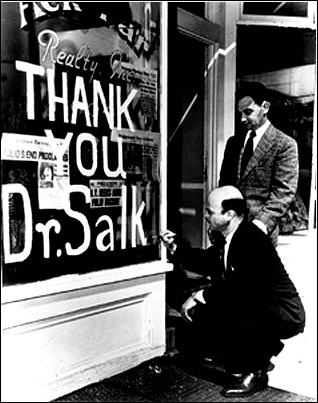
At the time, the creator of the vaccine, Jonas Salk, MD, was hailed as a hero. He became a household name.
The nurse who administered Ferguson's COVID-19 vaccine was startled by her reaction and asked if he had hurt her.
“I said, ‘If only I had had the Salk vaccine,’” Ferguson recalls.
The nurse asked, “What’s the Salk vaccine?”

Family photo courtesy of Carol Ferguson
The pain of a new diagnosis
Ferguson’s polio infection at age 2 left her with mild disabilities. She grew up with one leg shorter than the other. And because the muscles in one foot were weak, she often had trouble lifting it high enough to walk. People called her clumsy when she stumbled and fell.
The real pain began when Ferguson was in her 30s and 40s, when the muscles in her left leg grew weaker and began to spasm. An accident in 2000 led to pain in her upper back and neck that “became all-consuming.”
She visited multiple doctors over many years and was misdiagnosed five times with multiple sclerosis, a degenerative disease. She was 50 years old when she learned that her physical problems were caused by post-polio syndrome.
When a doctor suggested she would benefit from a leg brace, Ferguson said she “went down kicking and screaming” before agreeing to wear it.
After working so hard to overcome paralysis, it can be crushing for polio survivors to experience disability again.
Hearing a doctor recommend a leg brace “brings back a lot of emotions for them,” Ryan said. “They remember the kids teasing them, and they don't want to do it.”
Photo courtesy of Margaret Hinman
For many survivors, the idea of using a leg brace again “feels like a failure,” said Marny Eulberg, MD, a Colorado family medicine physician who is largely retired but treats people with post-polio syndrome out of her home office.
“The message I heard in the 1950s was, ‘If you just work hard enough, you can get rid of the crutch and the brace,’” said Eulberg, who contracted polio in 1950 at age 4.
Ferguson, now 74, said she now uses a brace on her left leg. She also uses an electric wheelchair to conserve energy and avoid exacerbating her symptoms.
“I don’t climb steps,” Ferguson said. “If I climb stairs, my hip goes in places it doesn’t belong.”
What causes post-polio syndrome?
In some ways, post-polio syndrome resembles a type of accelerated aging. Everyone experiences a gradual loss of neurons, or nerve cells, as they age. Most people aren’t affected by this loss until their 80s or 90s, Ryan said. But because the poliovirus kills and weakens neurons, a polio survivor at mid-life has a much lower supply.
With time and use, “it might make those damaged nerves drop off even quicker,” Ryan said. “So there’s an earlier loss of strength and more weakness.”
In spite of the damage or death of neurons, the muscles connected to those nerves are often undamaged. But they appear weak because the nerves that control them are exhausted, Ryan said.
If I climb stairs, my hip goes in places it doesn’t belong.
“There’s nothing wrong with the muscle,” said Ryan, who compared the muscles of polio survivors to a light bulb. “There’s a brand-new bulb, but it’s not turning on because the copper wire is dead or frayed and is not turning it on.”
Doctors who treat polio survivors often tell them to limit their physical activity. “You don't want to overdo it because you might make those nerves drop out faster,” Ryan said.
Managing the symptoms
Some patients come to Eulberg hoping to be cured.
But just as there’s no cure for polio, “there really isn’t a cure” for post-polio syndrome, Eulberg said.
“Once someone is diagnosed with post-polio syndrome, it’s not like you just take an antibiotic,” Eulbert said. “It’s more a matter of managing it. My goal is to help you do as many of the activities that are important to you as possible and for as long as possible.”
Depending on a patient’s needs, Eulberg said she can write prescriptions for braces and wheelchairs, as well as refer people for surgery.
“I tell them, ‘Here is what is going on, and here are some options,’” Eulberg said. “If the braces aren’t doing it anymore, you think about using a wheelchair. If the problem is fatigue, look at their physical activity and think about adding in some rest periods.”
A vanishing specialty
Ferguson’s experience has made her a fervent supporter of polio vaccines.

Photo courtesy of Chris Hornaman.
“No child should suffer from a vaccine-preventable disease,” Ferguson said. “The pain and disability can last a lifetime.”
Ferguson also has become an advocate for polio survivors.
She notes that there are too few specialists who know how to treat post-polio syndrome. Doctors who treated polio cases in the 1950s and 1960s have passed away. Young doctors don’t learn about polio in medical school.
Ferguson and other advocates founded Polio Survivors Serving Others, which provides information about post-polio syndrome and connects people with support. Post Polio Health International, an advocacy group, offers a directory of providers who treat the syndrome.
“I learned the heartbreaking reality of what polio survivors were going through,” Ferguson said. “I don’t want other polio survivors to go through what I did.”
Ryan said he still teaches medical residents about post-polio syndrome. But he is 63, and close to retirement age.
Eulberg, 79, said she plans to continue treating post-polio patients as long as she can.
“When I was getting close to 65, patients were asking me, ‘What are we doing to do when you retire?’” Eulberg said. “I said, ‘My mother lived to be 92, and her mind was good until the last day."